🥅 Net System Installation in Boise, ID
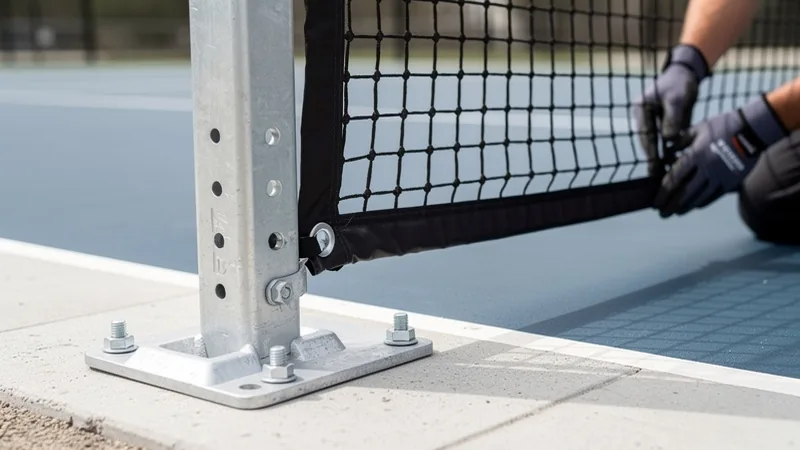
Boise Pickleball Courts provides net system installation in Boise, ID.
Free On-Site Estimates · Permits Handled · USAPA-Regulation Sizing
Permanent or portable net systems set to regulation height.
A permanent, ground-anchored net system is the standard for a dedicated court and holds regulation tension and height more reliably than a portable net that gets moved or adjusted often.
📞 Call (208) 361-3844Frequently Asked Questions
Do I need a permit to build a pickleball court in Boise?
In most cases yes — the City of Boise requires a permit for accessory structures over 120 square feet, which a full court's pad and fencing typically exceeds. We handle the permit application as part of every new-build job.
How much does a backyard pickleball court cost in Boise?
There is no official Boise price list; a published estimate puts one outdoor court built from scratch, with base, acrylic surface, net, fencing and lights, at about $25,000 to $45,000; repainting an existing sound slab can come in under $5,000. The builder gives a written price after seeing the site.
Can I add pickleball lines to my existing basketball or tennis court?
Yes, in most cases — line striping an existing sound court surface runs $1,500 to $4,000, one of the most cost-effective ways to add the game to a property that already has a hard court.
What areas do you serve around Boise?
Boise, Meridian, Eagle, Kuna, Star, and the rest of Ada County and the Treasure Valley, ID.
Is there a noise concern with pickleball courts near neighbors?
Yes — pickleball has a distinctive sound that some cities have started regulating with placement setbacks specifically for the sport, separate from standard property-line setbacks. We check your specific city's requirements during the estimate.
How do you handle Idaho's climate for the court surface?
Boise's hot, dry summers can soften and stretch acrylic coating over time, while winter freeze-thaw cycles stress the base and any existing cracks. We spec the base prep and coating type for this specific climate swing rather than a one-size-fits-all build.
How much space do I need for a backyard pickleball court?
The court itself is 20 by 44 feet for both singles and doubles, but you need room around it to play: USA Pickleball recommends a total playing area of about 30 by 60 feet, and 34 by 64 feet is the preferred size for full-speed play. On a tight Boise lot a 30 by 60 foot pad is the realistic minimum for a real game; anything smaller works as a practice court. Fencing, lighting poles and drainage all need to fit around that footprint too.
Can I build a smaller pickleball court in my backyard?
Yes. Plenty of homeowners build a half court or a shortened court for drills, dinking and kids, and it can fit where a full 30 by 60 foot pad won't. The trade-off is that a regulation game needs the full 20 by 44 foot court; a shorter one changes how the game plays, especially at the baseline. If space is the limit, a multi-sport pad that combines a practice pickleball court with a basketball key is often the best use of the yard.
How long does a pickleball court last, and how often does it need resurfacing?
The base is the long-term part: a well-built post-tensioned concrete slab can last decades, and asphalt typically 15 to 20 years before it needs major work, Idaho's freeze-thaw cycles being the main thing that cracks it. The acrylic color coating on top is the part you renew: usually every 4 to 8 years depending on sun, use and how well the court drains. Cracks should be filled as soon as they appear, before winter water gets into them.
Can you put sport court tiles on grass or gravel?
Not for a court you want to play pickleball on. Modular sport tiles need a hard, flat base, usually concrete or asphalt, to give a true bounce and stay level; on grass or gravel they shift, sink and the ball bounces unpredictably. A compacted, properly graded base is most of the work and most of what makes a court last.
Does a backyard sport court add value to a home?
It depends on the buyer. In neighborhoods where pickleball is popular, like much of Boise, Meridian and Eagle, a well-kept court can help a house stand out and sell to the right buyer; for buyers who'd rather have lawn it adds little. Treat it as something you build for your own use, and keep it in good shape so it reads as a feature rather than a slab someone has to remove.